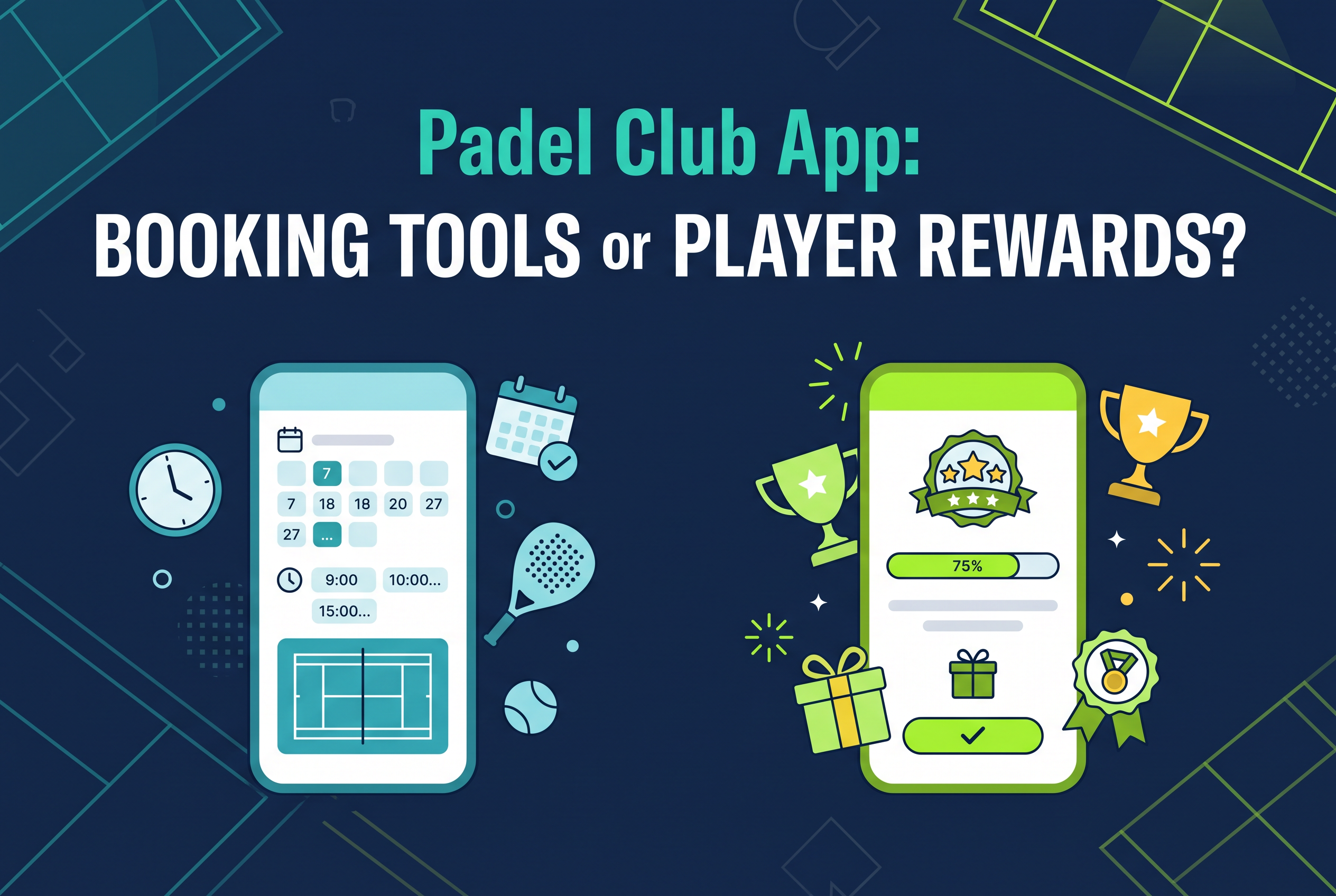
The best padel club app depends on which problem you are buying for. Booking apps fill your calendar, club-management systems run operations, and loyalty apps like Racqlo bring members back to play more often. "Padel club app" covers all of them, which is why comparison lists confuse owners.
If you run one or two UK sites, the useful question is not "which app ranks first" but "which job is unsolved at my club?" This guide sorts the category, gives you a checklist to run any vendor through, and says plainly where Racqlo fits and where it does not.
What people mean by 'padel club app' (and why the term covers four different tools)
A padel club app is any mobile product tied to a padel venue, and the phrase gets used for four unrelated jobs: players finding courts, clubs managing bookings and operations, businesses running generic loyalty schemes, and padel-specific rewards for members.
That is why searches like "best padel club apps" return a mix of marketplaces, app-store listings for individual clubs and software vendors. They are not competing for the same budget. A player searching "what is the best app to play padel" wants a court and a match. An owner searching the same words may want to stop members drifting away. Same keyword, different purchase.
Name your own job before you read a single feature list.
What is an official padel club app for memberships and court reservations?
An official club app is the one a venue picks as its own, so members use it to book courts and manage their membership. There is no single official padel app in the UK. The label usually means a booking or club-management tool. Racqlo does neither. It is a loyalty and rewards app for padel and racquet clubs, covering check-in points, membership tiers and campaigns. It sits alongside booking software and does not replace it.
The four app categories: player booking apps, club management, generic loyalty, padel loyalty
The four categories are player booking and marketplace apps, club-management systems, generic loyalty tools, and padel-specific loyalty. Each answers a different question, and each gets judged on different criteria.
Player booking and marketplace apps. These are built for players to find courts and people to play with. Playtomic describes itself as an app for racket sport players and clubs, where players can create private matches, make them public to find partners, search active matches nearby, and see a player level estimate. It also offers clubs a way to manage their racket club in one place. MATCHi positions itself as a complete booking system for racket sports venues, covering tennis, badminton, table tennis, squash and padel.
Club-management systems. This is the operations layer: calendars, court availability and the back office. Several of the booking products above overlap with it, so check whether a vendor is a marketplace, a management system, or both.
Generic loyalty tools. Loyalzoo offers customisable points, stamps and tiered rewards, SMS, email and push messaging, and subscriptions, aimed at independent businesses across sectors. Stamp Me is a digital stamp card app where customers collect stamps via its app, web app or Apple and Google Wallet. Both are built for cafes, shops and similar businesses, not for court hours.
Padel-specific loyalty. This is where Racqlo sits: a loyalty and rewards app for padel and racquet clubs, built around check-ins, points, tiers and club campaigns.
| Category | Main job | Example products |
|---|---|---|
| Player booking and marketplace | Find courts and matches | Playtomic, MATCHi |
| Club management | Run bookings and operations | Playtomic and MATCHi venue tools |
| Generic loyalty | Points or stamps for any retailer | Loyalzoo, Stamp Me |
| Padel loyalty | Reward visits, tiers and events at racquet clubs | Racqlo |
Which app handles club management, bookings, rankings and tournaments?
Club-management software handles bookings, court schedules, memberships and often tournaments and rankings in one system. Rankings and tournament tools usually come from those platforms or from league apps. Racqlo is not one of them. It does not take bookings or run tournaments. It counts check-ins, awards points, moves members up tiers and lets you run quiet-slot discounts and campaigns. Many clubs pair a management tool with a loyalty app.
Booking tools vs player rewards: which problem are you actually solving?
Buy booking software if people cannot easily reserve a court. Buy a rewards app if they can book fine but do not come back often enough.
A quick diagnostic:
Players say they cannot find or book a slot. That is a booking problem. A marketplace or booking system is the fix.
Courts are bookable but quiet at predictable times. That is a demand and habit problem. Rewards, quiet-slot offers and events address it.
New members play a couple of times and disappear. That is a retention problem, and a booking tool will not change it.
You cannot tell who your regulars are. That is a recognition problem. Check-in data and tiers solve it.
Most owners already have some way to take bookings. If that is you, a second booking product adds cost and leaves the real gap untouched. If you have no booking system at all, start there, because rewards need visits to count.
The design questions, such as how many points a visit is worth and how to structure tiers, are covered in Padel Club Loyalty Programme: Points, Tiers and Rewards. This guide is about choosing the category first.
What features should a padel club app have for booking, memberships and events?
Court booking, membership management and event or tournament organising belong to booking and club-management software. Rewards and engagement features are a separate set: check-in points, membership tiers, quiet-slot discounts, member segments, automated campaigns and push or email announcements. Racqlo provides that second set, including a QR check-in pass. Court booking and event-management capabilities are not confirmed in the published Racqlo feature list, so ask about these separately.
A checklist for evaluating any padel club app before you pay
Judge any padel club app on who it serves, what it replaces, what it costs at your member count, and what happens to your members' experience. Put these questions to every vendor:
Whose app is it? Is the product built for players first (marketplace) or for your club first (your members, your offers)?
What job does it do on day one? Booking, management, retention or messaging. If the answer is "all of it", ask which part is strongest.
What does it replace? If it duplicates a tool you already pay for, count that cost.
How is it priced against your size? Ask for the price at your active member count and number of locations, in writing.
What does a member do on arrival? Fewer steps at the desk means more staff time and more adoption.
Can you contact members directly? Check for push and email, and whether you can target a subset rather than blast everyone.
Can you see court usage by day and hour? You cannot fix quiet slots you cannot see.
Which features are in the plan you are quoted? Features, member caps and location limits vary by tier.
Is it on the app stores you need? If iOS and Android availability matters to your members, ask for the live listing rather than accepting a promise.
A vendor that cannot answer these in plain terms is telling you something.
How do I choose a padel club app that is worth paying for?
Choose by the problem you need solved, not by the year or the longest feature list. If courts are full but members drift away, you need loyalty and engagement. If you cannot take reservations, you need booking software. Check that pricing is published, the plan fits your member count, and you can see how it works before paying. Racqlo's published plans run from £99 a month, with Starter for up to about 300 members. Ask any vendor for a walkthrough.
Where Racqlo fits: rewards and engagement for padel and racquet clubs
Racqlo is a loyalty and rewards app for padel and racquet clubs. It is not a booking system. It counts every check-in, awards points on the spot, and moves members up membership tiers you configure.
Members show one QR pass on entry. For the operator, the club console covers the day-to-day engagement work:
Quiet-slot discounts. Racqlo includes quiet-slot discounts and push or email announcements.
Points and tiers you control. Set what a visit is worth, what unlocks a tier, and which rewards members can claim.
Member segments and campaigns. Racqlo includes member segments, automated campaigns and push or email announcements.
Published plans are Starter at £99/mo for up to 300 members, Growth at £129/mo for up to 1,000 members, and Pro at £159/mo for 2 locations and up to 2,000 members. Pro covers two locations. Operators with more sites should expect a custom conversation.
Racqlo answers the "they book but do not return" problem. Court reservations are not listed among its confirmed features.
Can you run booking and loyalty together? Questions to ask before you decide
Yes. Many clubs run a booking tool and a loyalty layer side by side because they solve different problems, but confirm how the two will work in practice before you commit to both.
Ask these questions of each vendor:
Where does the member sign in? Two apps means two downloads. Decide whether that friction is acceptable for your members.
What data does each side hold? Bookings sit in one system and check-ins in another. Decide which one you treat as the source of truth for who is a regular.
Who handles the member message? If both products can send notifications, agree which one speaks to members and when, so they do not get duplicates.
Does the front desk cope? A QR check-in on entry is a small extra step. Walk through it at your busiest hour.
What does it cost together? Add the booking software, the loyalty plan and any payment fees, then compare against the court hours you hope to recover.
If a vendor claims a direct connection between its booking system and a rewards app, ask them to show it working at a live club, not on a slide. A sensible order for most owners: get booking sorted, then add rewards to lift how often people play.
Pick the problem first, then book a Racqlo walkthrough
A padel club app is only the right one if it solves the problem you actually have. If your members can book but too few return, and your courts sit quiet at the same hours each week, the gap is rewards and engagement, not another booking screen. Racqlo is built for that job, starting at £99/mo. Contact Racqlo for a walkthrough at racqlo.com and bring your quietest court hours with you.
Questions
What is the best app to play padel?
For players finding courts and matches, marketplace apps such as Playtomic and MATCHi are the usual starting points, since they handle court search, booking and partner finding. For clubs wanting members to play more often, a rewards app such as Racqlo adds check-in points, tiers and campaigns. They solve different problems, so many clubs end up using both.
Is there an app for padel clubs?
Yes, several kinds. Booking and management platforms such as Playtomic and MATCHi serve venues and players, generic loyalty tools such as Loyalzoo and Stamp Me serve any small business, and Racqlo is a loyalty and rewards app built specifically for padel and racquet clubs, with check-in points, tiers and a club console.
What is a padel club?
A padel club is a venue with padel courts where members and visitors play, often alongside coaching, socials and tournaments. Many clubs are membership-led, which is why retention matters: courts earn money when regulars keep turning up. Racqlo supports that side by rewarding every visit and helping clubs fill quiet court hours.
Does Racqlo take court bookings?
No. Racqlo is a loyalty and rewards app, not a booking system. Clubs that need reservations pair it with whichever booking tool they already use.